
Reduced Purchase Price or Seller Concessions — What Makes the Most Difference for the Buyer?
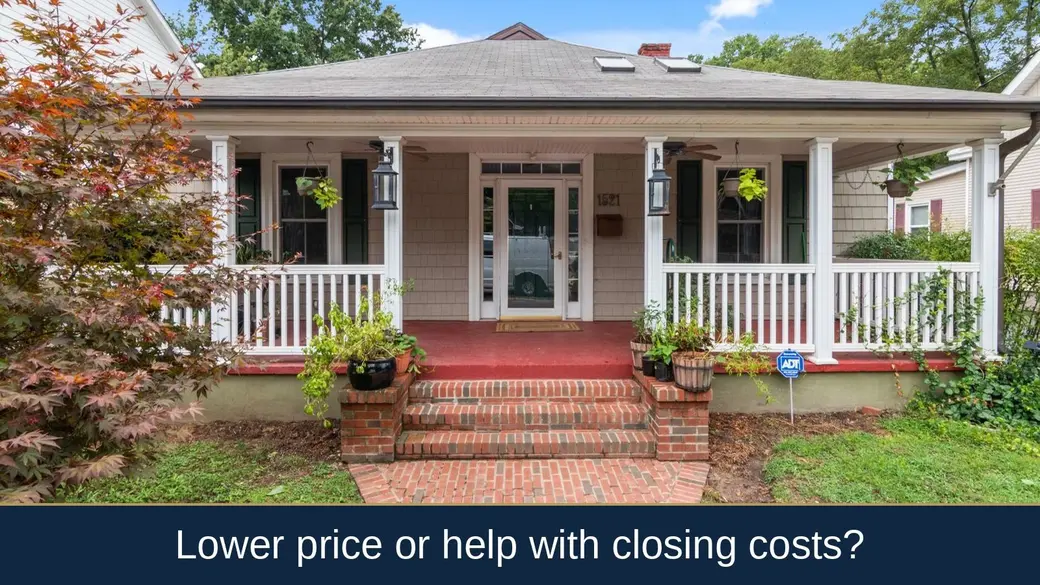
You find a home you love at $225,000, and the seller is willing to work with you on $5,000. Do you offer $220,000? Or do you offer $225,000 and ask the seller to put $5,000 toward your closing costs?
Before we write the offer, I’d ask you two questions. Do you have the cash you need to close? And if you do, how much of it do you want to spend getting the keys?
What does $5,000 look like each way?
Let’s say you’re putting 5% down on a conventional loan and your lender estimates $6,000 in eligible closing costs and prepaid expenses. We’ll use a 30-year fixed loan at an illustrative 6.5% and assume the lender approves the full credit.
| $5,000 off the price | $5,000 toward closing costs | |
|---|---|---|
| Purchase price | $220,000 | $225,000 |
| Your 5% down payment | $11,000 | $11,250 |
| Closing costs and prepaids you cover | $6,000 | $1,000 |
| Total cash needed before any deposits | $17,000 | $12,250 |
| Monthly principal and interest | $1,321 | $1,351 |
These monthly figures cover principal and interest only. Your full housing payment can also include taxes, homeowners insurance, mortgage insurance and any HOA dues.
With the lower price, you borrow $4,750 less and save about $30 a month in principal and interest. With the seller credit, you keep $4,750 more in your account at closing. Why $4,750? Your down payment is $250 higher at the original price.
Say you have $14,000 available for the purchase. In this example, you’re $3,000 short with the lower price. With the seller credit, you can cover closing and still have $1,750 in the bank. That changes which offer you can actually make.
Even if you have the full $17,000, you might want to keep some of it for a fridge, a couch that fits the new living room, or simply because you like having money in the bank. And if your priority is a lower monthly payment, look at what the price reduction actually does. Would that $30 a month make enough of a difference to you? You can also ask your lender to price a rate buydown using some of the seller credit. Have them show you how much it would lower your payment and how much cash you’d still need to close.
How does the seller see those same two offers?
If I’m sitting down with the seller, their question is usually, “What am I walking away with after everything is paid?” A $220,000 offer with no credit and a $225,000 offer with a $5,000 credit both leave $220,000 before the seller’s other expenses. Some selling costs depend on the sale price, so I’d run a net sheet for each offer to show their estimated proceeds after closing costs and any mortgage payoff.
The seller could walk away with nearly the same amount either way. Meanwhile, on your side of the very same deal, there’s a $4,750 difference in what you need to bring. That’s why it’s worth figuring out where those dollars will do the most for you before we start negotiating.
What changes if you’re using down payment assistance?
Let’s say you qualify for North Carolina’s $15,000 NC 1st Home Advantage Down Payment. Can you also ask the seller to help with closing costs? Yes. But before we write “3%” or “6%” into an offer, I want your lender to answer two questions. How much will your loan allow the seller to contribute? And after we apply the assistance, how much of that credit can you actually use?
Go back to our $225,000 home and the $5,000 the seller is willing to give. Suppose your lender runs your numbers with the assistance and finds you have $3,000 in eligible costs left. Asking for 3% would mean asking for $6,750 when you only have $3,000 in costs to cover. You can’t take the difference home or use a conventional seller credit for your down payment.
So what would I put on the table? An offer of $223,000 with $3,000 toward your closing costs. You’ve asked the seller for the same $5,000 overall. You’ve directed $3,000 where your lender says you can use it and put the other $2,000 toward a lower price.
This is why I like to bring your lender into the conversation early. If keeping cash in the bank is your priority, let’s see what you’d need to bring to closing with each option. If it’s the monthly payment you’re watching, your lender can compare a lower purchase price with a rate buydown, if your loan allows it. Once you see what each option means for you, we can decide together what to ask the seller for.
Before we write your offer, speak with your lender about how much you’ll need at closing and what your monthly payment could look like each way. If you need a lender referral, reach out. I’d be happy to connect you.
Roxanne Redar, NC REALTOR® | SFR®
Call It Closed International Realty
Seller contribution guidelines — Fannie Mae · How mortgage discount points work — CFPB · North Carolina down payment assistance — NCHFA
Disclaimer: The figures in this article are estimates. Your lender will apply your loan program’s guidelines to determine how much the seller can contribute toward your eligible costs. Your actual cash to close and monthly payment will depend on your final loan terms, fees, taxes, insurance, and any approved assistance or seller credits. Review your Closing Disclosure with your lender to confirm your final numbers.
Recent Posts








GET MORE INFORMATION
Roxanne Redar
Real Estate Agent License ID: 352352
Real Estate Agent License ID: 352352