

Before You Renovate to Sell: What Buyers Actually Care About
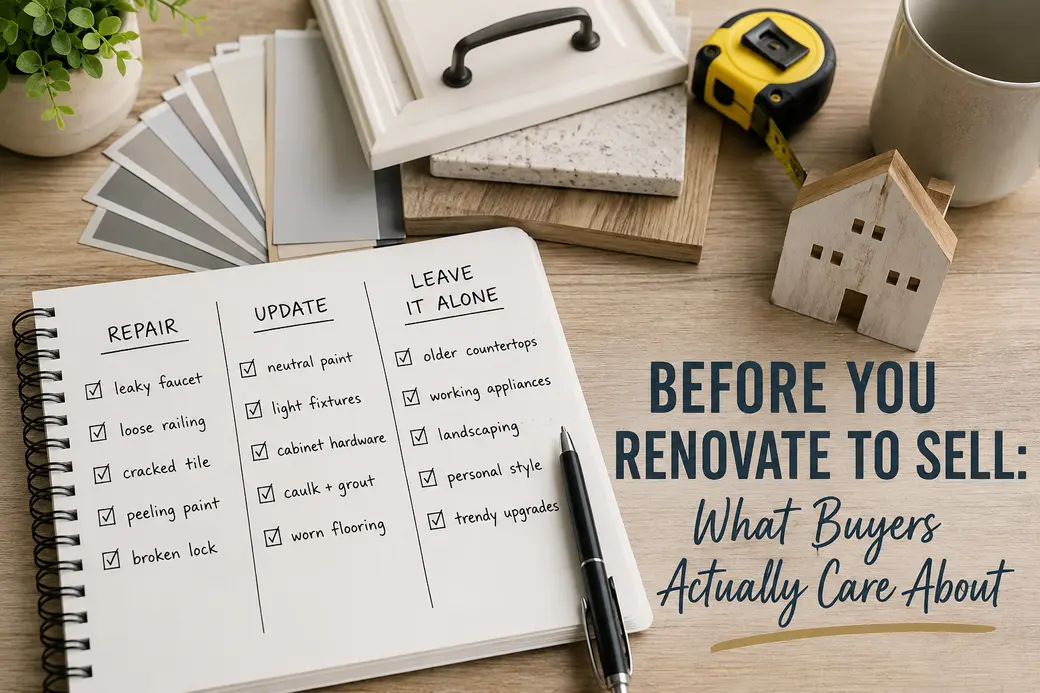
A few weeks ago, we tackled the first step in getting your home ready to sell: cleaning, decluttering and depersonalizing.
Now comes the question sellers ask me all the time:
What do I actually need to fix or update before I sell—and what can I leave alone?
Getting your home ready to sell does not mean you need to turn it into a brand-new house.
That is where a lot of sellers get tripped up.
They start thinking about new countertops, new flooring, new appliances, a bathroom remodel, fresh landscaping, cabinet updates—and suddenly getting ready to list feels more like getting ready for a renovation show.
But here is the question I would rather a seller ask:
Will this actually matter to a buyer?
Because there is a big difference between spending money that improves how buyers see your home and spending money simply because you think everything needs to be “updated.”
So let’s break it down:
What should you repair? What is worth updating? And what should you leave alone?
REPAIR IT: Fix the Things That Create Doubt
Buyers do not expect every home to be perfect.
What they do notice is whether a home appears to have been taken care of.
That distinction matters.
A dripping faucet probably is not going to make someone walk away from your house. Neither is a loose cabinet handle or a cracked switch plate.
But when buyers start seeing one small problem after another, something changes.
Instead of thinking:
That’s an easy fix.
They start thinking:
What else hasn’t been maintained?
That is when relatively minor issues can begin affecting how buyers feel about the entire property.
Before listing, I would pay attention to things like:
-
Active leaks or visible water damage
-
Plumbing or electrical problems
-
HVAC systems that are not functioning properly
-
Rotten or damaged exterior wood
-
Broken doors, windows, locks or railings
-
Damaged flooring
-
Peeling paint or obvious drywall damage
-
Loose toilets, running toilets or dripping faucets
-
Broken switches, outlets or fixtures
-
Missing trim, hardware or outlet covers
-
Unfinished repair projects
Here is something sellers sometimes underestimate:
One small repair looks like a repair. Ten small repairs can look like deferred maintenance.
And once buyers start mentally creating a repair list, that list usually becomes more expensive in their minds than it actually is.
UPDATE IT: When a Small Change Makes a Big Difference
This is where strategy really matters.
You do not necessarily need to renovate a room for it to feel better.
Sometimes relatively simple changes can make a home feel noticeably fresher, brighter and more current.
Fresh paint can make a huge difference—but if you are painting specifically to sell, keep the color neutral.
Strong or highly personal colors can make it harder for buyers to picture themselves in the space. A soft neutral creates a cleaner backdrop and lets the home itself take center stage.
And neutral does not have to mean stark white.
Warm whites, soft creams, light greiges and other subtle neutrals can make a home feel fresh, bright and current without making it feel cold or sterile.
Other updates worth considering may include:
-
Changing obviously dated light fixtures
-
Replacing worn or dated cabinet hardware
-
Refreshing old caulk or grout
-
Replacing damaged or heavily worn flooring
-
Updating inexpensive fixtures that noticeably age a room
-
Improving lighting in dark spaces
-
Replacing broken or very worn hardware
-
Making simple cosmetic changes that photograph well
The question I like to ask is:
Will this noticeably improve the buyer’s first impression of the home?
Think about the listing photos.
Think about the first five minutes of a showing.
If the improvement changes how the home looks or feels during those moments, it may be worth considering.
If it doesn’t?
We should probably have a conversation before you spend the money.
LEAVE IT ALONE: Not Everything Needs to Be Updated
This may be the most important part of the conversation.
There are plenty of things sellers spend money on before listing that buyers never asked them to do.
A kitchen does not automatically need to be remodeled because it is ten or fifteen years old.
Perfectly functional countertops do not necessarily need to be replaced because another material happens to be trending.
Good flooring does not always need to come out simply because it is not what you would choose today.
And you certainly do not need to redesign your house around a buyer you have not even met yet.
Before taking on projects like these, I would think carefully:
-
A complete kitchen renovation
-
A complete bathroom renovation
-
Replacing functional countertops simply because they are dated
-
Purchasing expensive new appliances just for the sale
-
Replacing flooring throughout the entire home when most of it is still in good condition
-
Repainting or replacing perfectly functional cabinetry
-
Investing heavily in elaborate landscaping
-
Adding expensive smart-home technology
-
Making highly personal design upgrades
-
Converting rooms into specialized spaces
-
Choosing expensive trendy finishes because you assume buyers will love them
Here is the risk:
You may spend thousands creating your version of an updated house only for the buyer to walk in and immediately imagine changing it again.
Design is personal.
Your favorite countertop may not be theirs.
Your flooring choice may not be theirs.
Your cabinet color may not be theirs.
Sometimes selling the home in good, clean, well-maintained condition—and allowing the next owner to make those choices—is the smarter financial decision.
What Buyers Notice More Than Sellers Think
Sometimes the things that influence a buyer most are not the expensive things.
Condition
Does the house feel like it has been maintained?
Buyers tend to be much more comfortable making an offer when they feel confident the home has been cared for.
Cleanliness
Kitchens, bathrooms, floors, baseboards, windows and trim matter.
A clean home often feels newer and better maintained even when the finishes themselves are not new.
Smell
This one gets overlooked.
Pet odors, cigarette smoke, moisture and strong fragrances can immediately affect a buyer’s impression of a home.
And trying to cover an odor with heavy air fresheners usually does not solve the problem.
Light
Dark rooms can feel smaller and older.
Sometimes better bulbs, clean windows, open blinds and strategically placed lighting can change the entire feel of a space without any renovation at all.
Consistency
This is another one people do not always think about.
A beautifully renovated kitchen beside several obviously neglected rooms can actually make those neglected areas stand out more.
You do not necessarily need every room to be updated.
But you do want the home to feel cared for as a whole.
The Little Things
Loose handles.
Doors that stick.
Missing trim.
Cracked outlet covers.
Burned-out light bulbs.
An unfinished patch on the wall that has been there for three years.
Individually, none of these things are major.
Together, they create an impression.
Buyers Don’t Expect Brand New. They Do Expect Cared For.
That is really the heart of this conversation.
Most buyers understand that an existing home has been lived in.
They know finishes age.
They know homes require maintenance.
And they know they may eventually want to make changes of their own.
What buyers generally do not want is to walk into a house and immediately feel like they are inheriting someone else’s neglected repair list.
There is a huge difference between:
“I would eventually update this bathroom.”
and
“I need to fix this bathroom.”
The first feels like a future choice.
The second feels like an immediate expense.
And that difference can absolutely influence how a buyer views your home—and what they are willing to pay for it.
Before You Spend Thousands, Start With a Walk-Through
One of the smartest things a seller can do before making major improvements is have their REALTOR® walk through the home with them.
Before you order new countertops…
Before you replace all the flooring…
Before you start tearing apart the bathroom…
Let’s look at the house through a buyer’s eyes.
Sometimes my recommendation may be:
Fix it.
Sometimes it may be:
Update it.
And sometimes the smartest advice may be:
Leave it exactly as it is.
Preparing your home for the market is not about making everything new.
It is about knowing where your money is most likely to make a difference—and where it probably won’t.
And that strategy should happen before the renovation starts.
Before you renovate for a buyer you haven’t met yet, let’s talk. A simple walk-through could save you time, money—and a few unnecessary projects.
Recent Posts







GET MORE INFORMATION

Roxanne Redar
Real Estate Agent License ID: 352352
Real Estate Agent License ID: 352352